
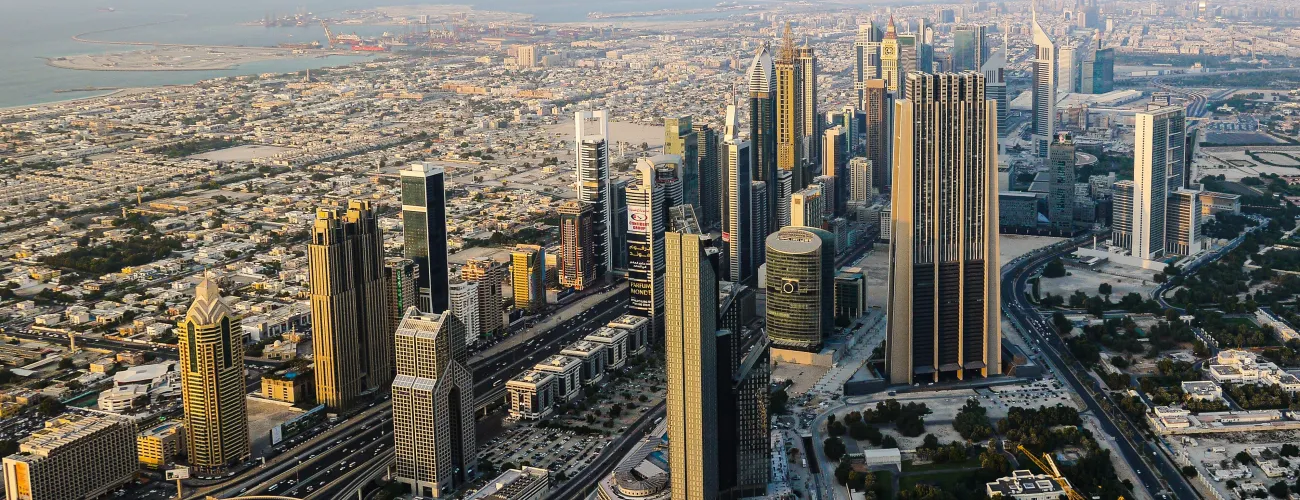
Geography, Data & Facts
Dubai is one of the seven emirates of the United Arab Emirates (UAE) and, at the same time, one of the region's most internationally renowned centers for business, tourism, and trade. The emirate is located on the coast of the Arabian Gulf and covers an area of approximately 4,114 km². This makes Dubai the second-largest emirate in the United Arab Emirates after Abu Dhabi. The coastline stretches for about 72 kilometers .
Dubai borders [country] to the south Abu Dhabi , bordering to the northeast on Sharjah and to the southeast, bordering the Sultanate of Oman . Thanks to its geographic location between Europe, Asia, and Africa, Dubai has become one of the most important international hubs for Air Travel, Trade, Logistics, Tourism, and Business developed.
Dubai's population continues to grow rapidly and stood at the end of approximately 4.58 million residents in 2025. A large portion of the population consists of international residents and expats, making Dubai one of the most multicultural cities in the world today.
The official language of the United Arab Emirates is Arabic . In everyday life, however, English: the language of general communication and everyday life and is used almost as a matter of course, particularly in companies, hotels, restaurants, stores, real estate, banks, and many service industries. Street and business signs are also generally written in Arabic and English.
The local currency is the UAE Dirham (AED). The dirham is pegged to the U. S. Dollar; the official exchange rate is about 1 USD = 3.6725 AED . The time zone in Dubai is Gulf Standard Time (GMT+4). There is no switch to daylight saving time or standard time.
Dubai has a hot desert climate with plenty of sunshine throughout the year. Average temperatures in winter are around 23 °C , whereas in the summer they are about 41 °C can be reached. The months from fall through spring are therefore considered a particularly pleasant time to travel, especially for visitors.
Dubai also has excellent international connections. The Dubai International Airport (DXB) recorded in 2025 with 95.2 million passengers set a new record and served over 290 destinations in more than 100 countries . This makes Dubai one of the world's most important international aviation hubs.
Among the best-known neighborhoods and regions are Downtown Dubai, Dubai Marina, Palm Jumeirah, Business Bay, Jumeirah, Deira, Bur Dubai, and Jumeirah Beach Residence (JBR). At the same time, Dubai is continuously developing new residential, commercial, and tourist areas and is now one of the fastest-growing cities in the region.
Dubai at a Glance
- Country: United Arab Emirates
- Emirate: Dubai
- Area: approx. 4,114 km²
- Population: approx. 4.58 million (as of the end of 2025)
- Coastline: approx. 72 km
- Official language: Arabic
- Everyday language: mostly English
- Currency: UAE Dirham (AED)
- Exchange rate: 1 USD ≈ 3.6725 AED
- Time zone: GMT+4
- International dialing code: +971
- Dubai area code: 04
- Climate: hot desert climate
- Winter temperature: an average of about 23 °C
- Summer temperature: an average of about 41 °C
- International Airport: Dubai International Airport (DXB)
- DXB Passengers in 2025: 95.2 million
Distance to Abu Dhabi: about 140 km by road
In this section of Dubai-Life. com here you'll find data, facts, and background information on Geography, Population, Climate, Infrastructure, Economy, and Development of Dubai and the United Arab Emirates – compact, constantly updated, and clearly organized.