
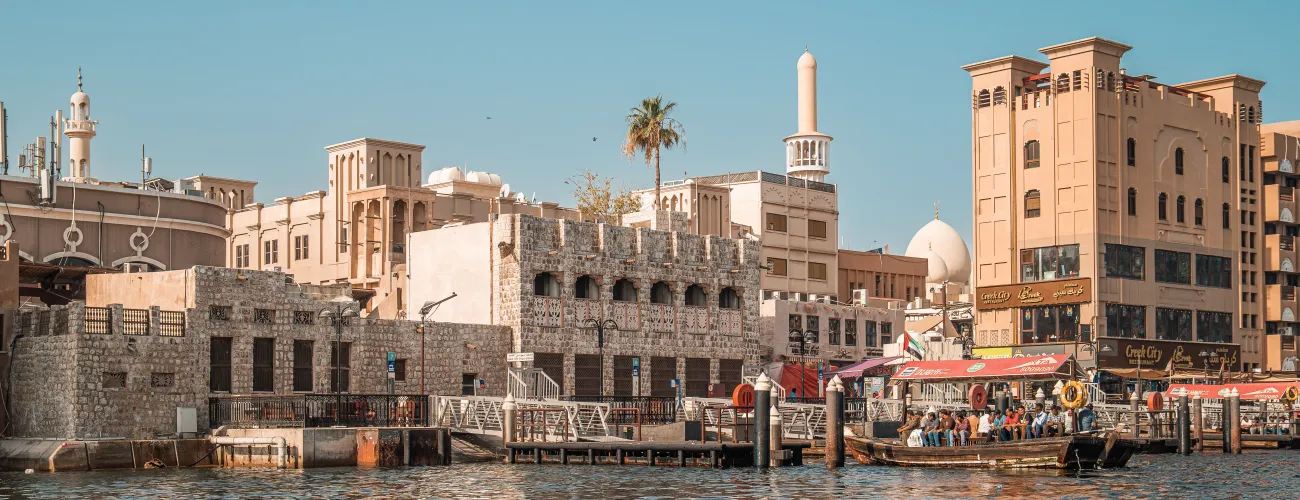
History of Dubai
Dubai's history is closely tied to trade, seafaring, pearl diving, and its strategic location on the Arabian Gulf. Long before the city became an international hub for business, tourism, and real estate, Dubai was a small settlement with a natural harbor on the Dubai Creek , which played a crucial role in regional trade.
Archaeological findings show that the area that is now the United Arab Emirates has been inhabited for thousands of years. However, the 19th century was particularly significant for Dubai’s modern development. In the year 1833 the family was able to Al Maktoum settled in Dubai and assumed leadership of the emirate. Since then, Dubai has been ruled by the Al Maktoum dynasty.
During the 19th and early 20th centuries, Dubai increasingly developed into a major trading center in the Gulf. The Dubai Creek was the economic center of the city. Merchants from the region, as well as from Persia, India, and East Africa, came to Dubai to buy, sell, and transship goods. At the same time, the Pearl Diving plays a significant role in the local economy and in providing a livelihood for many families.
A major turning point came at the beginning of the 20th century, when Dubai further expanded its position as an open trading center. The rulers of the time actively promoted trade and created relatively attractive conditions for merchants. As a result, Dubai increasingly developed into a regional trading hub.
However, the traditional pearl industry came under severe pressure in the 1920s and 1930s. The Great Depression, coupled with the increasing popularity of cultured pearls from Japan, led to a sharp decline in the importance of this key economic sector. Dubai had to reorient its economy and placed even greater emphasis on trade, the port industry, and services.
A decisive step toward a modern Dubai began in the the 1950s and 1960s . Under Sheikh Rashid bin Saeed Al Maktoum, a period of extensive infrastructure investment began. Dubai Creek was expanded and deepened, roads were built, new public facilities were created, and the foundations for a modern business hub were laid.
With the discovery of Oil in Dubai in 1966 the emirate gained additional financial resources for its development. Dubai began exporting oil as early as 1969. Unlike many other countries and regions in the Gulf, however, Dubai made a conscious decision early on not to make its economy permanently dependent on oil. The revenues were strategically invested in infrastructure, trade, ports, airports, and other economic sectors.
On december 2, 1971 dubai joined Abu Dhabi, Sharjah, Ajman, Umm Al Quwain, and Fujairah to become one of the United Arab Emirates together. Ras Al Khaimah joined the federation in 1972. To this day, that date is considered one of the most important milestones in the history of the United Arab Emirates.
In the decades that followed, Dubai began its extraordinary economic growth. Major infrastructure projects were carried out, including the expansion of the Port Rashid , the development of the Jebel Ali Port and later the establishment of the Jebel Ali Free Zone . These projects significantly strengthened Dubai's position as an international trade and logistics hub.
In particular, the establishment and development of free zones became a key component of the economic strategy. International companies were offered attractive conditions to set up operations in Dubai. At the same time, tourism, real estate, financial services, aviation, technology, and international services were consistently expanded.
In the the 1990s and 2000s development accelerated significantly once again. With projects such as the Burj Al Arab , the Palm Jumeirah , Dubai Marina, Downtown Dubai, and numerous new business and residential districts have shaped the international image of Dubai that is known worldwide today.
Another symbol of this trend is the Burj Khalifa , which opened in 2010 and, at 828 meters, remains one of the world's most famous structures to this day. Together with the Dubai Mall and Downtown Dubai, a new hub for tourism, retail, real estate, and international brands has been created around the Burj Khalifa.
At the same time, the following developed: Emirates Airlines , founded in 1985, has become one of the leading international airlines. The expansion of Dubai International Airport played a key role in establishing Dubai as a global hub connecting Europe, Asia, Africa, and Australia.
Today, Dubai's economy is based on a wide range of sectors. These include, among others, Retail, tourism, air travel, logistics, real estate, financial services, technology, international business services, and, increasingly, future-oriented digital industries . Today, oil plays only a relatively minor role in Dubai's economic performance.
Dubai continues to pursue a long-term growth strategy. New neighborhoods, infrastructure projects, business locations, and tourist attractions are constantly being developed. At the same time, the emirate is increasingly positioning itself as an international hub for Innovation, artificial intelligence, technology, the digital economy, and sustainable urban development .
Important Milestones
- 1833: The Al Maktoum family takes the reins in Dubai
- 19th century: Expansion of Trade, Shipping, and the Pearl Industry
- Early 20th century: Dubai is establishing itself as a regional trading hub
- 1950s/1960s: Infrastructure Development and Dubai Creek
- 1966: Discovery of Oil
- 1969: Start of Oil Exports
- 1971: Founding of the United Arab Emirates
- 1970s/1980s: Expansion of Ports, Airports, and International Trade
- 1985: Founding of Emirates Airline
- 1985: Establishment of the Jebel Ali Free Zone
- 1990s/2000s: significant growth in tourism, real estate, and international business hubs
- 2010: Opening of the Burj Khalifa
- Today: Dubai continues to evolve into a global hub for business, technology, tourism, and international investment
Dubai's development is thus one of the most extraordinary economic and urban transformations of the past few decades. Within just a few generations, it has evolved from a regional trading and port hub into a world-renowned metropolis.
In this section of Dubai-Life. com here you'll find information about Dubai's history, its most influential figures, historic neighborhoods, key phases of development, and the milestones that have made Dubai what it is today.